
How Should Charge Weight Be Calculated in Air Cargo?
Pricing weight in air cargo is the basic measure that determines the weight on which the transportation fee will be calculated. In air transportation, not only the actual weight of the product on the scale is taken into consideration. At the same time, the area it occupies is also taken into account. Because aircraft cargo capacity is limited not only by kilograms but also by volume. For this reason, a small-volume but heavy load and a light but space-consuming load cannot be evaluated with the same logic. The charging weight calculation is used to offset exactly this difference. If this calculation is not made correctly, the cost estimate may be erroneous, price quotes may be incorrect and the operation plan may be disrupted.
On the air cargo side, weight calculation means pricing for the sales team, load plan for the operations team, and quote accuracy for the customer. If the actual weight of a shipment is low but its volume is large, the carrier has to allocate more space for that load. Therefore, in most cases, the charge is based on the greater value between the actual weight and the volumetric weight. So just knowing how many kilograms the product weighs is not enough. The measurements must also be taken correctly. In air cargo operations, this calculation forms the basis of the entire process, from the bidding stage to the booking decision.
Therefore, the issue of pricing weight is not just a matter of technical formula. It is also directly related to the quality of operation. Incorrectly measured parcel dimensions, incompletely entered package information or incorrect conversions may disrupt the cost calculation. When a low price is calculated for a shipment, there may be a price difference later. When a high price is calculated, commercial competition weakens. It is very important to make this calculation correctly, especially since speed, capacity and cost are managed simultaneously in air transportation. at this pointlogistics softwareBusinesses that use it can reduce the risk of errors by following the size, weight, number of boxes and pricing logic in a more controlled manner.
What is the Weight Charge for Air Cargo?
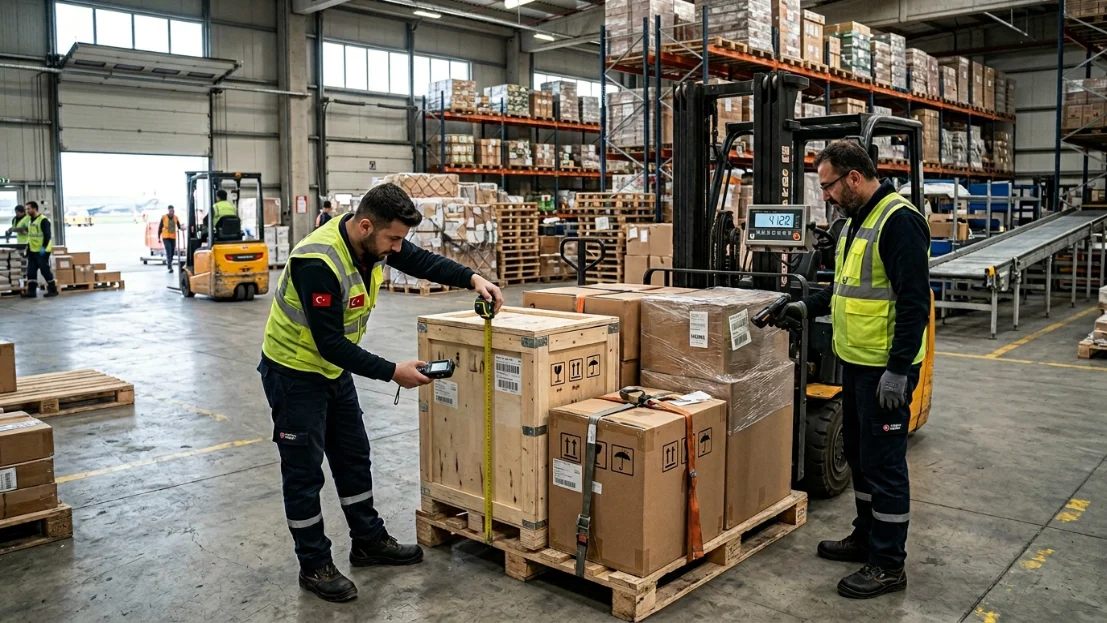
Pricing weight in air cargo is the weight value used in calculating the transportation cost. This value is determined by comparing the actual weight of the load with its volumetric weight. Actual weight is the kilogram value obtained as a result of weighing. Volumetric weight is the value calculated according to the width, length and height dimensions of the load. The carrier company charges based on the higher of these two values.
The main reason for this approach is that air cargo capacity cannot be evaluated only in kilograms. Large volume loads as well as heavy loads affect capacity utilization in the aircraft. If a very light load takes up a large volume, there is a significant use of space on the aircraft for the carrier. Therefore, volumetric weight can be as decisive as actual weight in air cargo pricing.
Knowing the charging weight correctly is important not only for freight calculation but also for operation planning. If it is clear in advance what value the cargo will be priced at, customer offers will be prepared more accurately, cost deviations will be reduced and unexpected differences will not arise at the invoice stage.
What is the Difference Between Actual Weight and Volumetric Weight?
Actual weight shows how many kilograms the load weighs physically. When the cargo is placed on the scale, the measured value is the actual weight. Volumetric weight is the mathematical conversion of the area occupied by the load into weight value. This calculation is especially critical in transportation types such as air cargo, where space usage has a direct impact on cost.
For example, in a small volume but heavy machine part, the actual weight may be higher. In this case, pricing is done based on actual weight. On the other hand, a light product carried in a large box may give a high value in terms of volume even if it appears low on the scale. In this case, the transportation cost is determined by volumetric weight.
Understanding this difference is very important for teams preparing proposals. In a shipment where the price is given only according to the weighing weight, if the volumetric weight is higher, a cost difference may occur later. This directly affects pricing with the customer, operational profitability and the invoicing process.
How to Calculate Charge Weight in Air Cargo?
Volume weight in air cargo is calculated by multiplying the width, length and height dimensions of the cargo and dividing the result by a certain coefficient. The commonly used formula is width x length x height / 6000. Measurements are taken in centimeters and the result is evaluated as kilograms.
For example, for a load measuring 100 cm x 80 cm x 60 cm, the volumetric calculation is made as 100 x 80 x 60 / 6000. As a result of this process, the volumetric weight is found to be 80 kg. If the actual weight of the load is 55 kg, the fee is based on 80 kg. Because in air cargo, the higher value is taken into account.
If there is more than one parcel, the calculation should be made more carefully. The size of each parcel can be calculated separately or evaluated based on the total volume. If the number of boxes is entered incompletely, the measurements are taken incorrectly, or the pallet size is not taken into account, the charging weight will be incorrect. This means low cost at the quote stage and unexpected difference at the invoicing stage.
What are the Factors Affecting Pricing Weight?
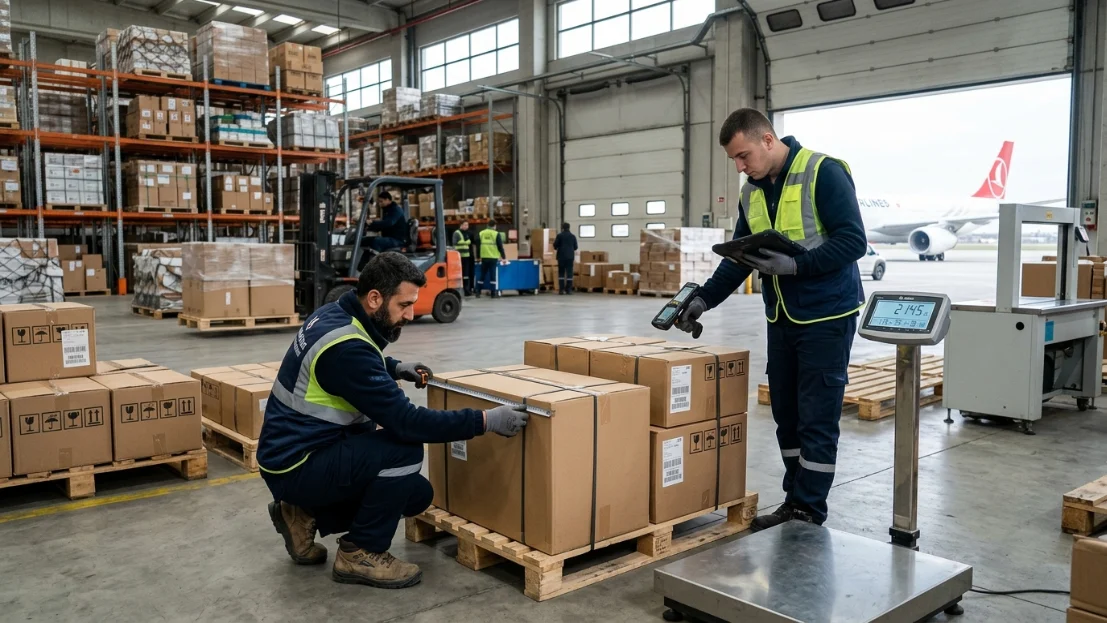
The main factors affecting the charging weight are the actual weight of the cargo, its volume, packaging structure, number of boxes and pallet usage. In air cargo operations, how the product is packaged as well as the product itself affects the cost. Volumetric weight may increase when the product is placed in larger boxes than necessary or when too much space is left in the packaging.
In palletized shipments, not only the size of the product but also the total size of the pallet should be taken into account. In some cases, even if the product is small, the area occupied by the load increases due to the palletization method. This may increase the cost of transportation. Likewise, irregular packaging, non-stackable parcel structure or special measurement criteria accepted by the carrier may also change the charging weight.
For this reason, when calculating, the weighing value of the load, package dimensions, number of boxes, pallet size, packaging type and the coefficient applied by the carrier company should be evaluated together. Correct packaging and accurate data entry ensure more predictable management of air cargo costs.
What Problems Can Miscalculation Cause?
Incorrect calculation of the charge weight may result in a difference between the quoted freight and the actual transportation cost. Especially since the costs of air cargo are higher than other types of transportation, even small measurement errors can significantly affect the total cost. This difference may lead to loss of trust on the customer side and loss of profitability on the operations side.
One of the most common mistakes is placing a bid based on actual weight only. However, if the volumetric weight is higher, the carrier company charges accordingly. In addition, taking incorrect box measurements, not taking pallet information into account, entering the number of boxes incompletely, or not checking the calculation coefficient used by the carrier may also cause cost deviations.
Incorrect calculation also affects operation planning. If the area occupied by the load is not predicted correctly, problems may occur in reservation, flight plan and capacity management. For this reason, measurement and weight information should be clarified before shipment begins, and pricing and operations teams should proceed based on the same data.
How Can the Remuneration Process Be Managed Easier?
In order to manage the pricing process more easily, measurement and weight information must be collected in a standard flow. For each shipment, width, length, height, actual weight, number of boxes, pallet information and carrier criteria should be recorded. When this information is kept in order, the proposal preparation process accelerates and calculation errors decrease.
Logistics programs provide significant convenience to operations teams in the air cargo pricing process. Load dimensions, actual weight, volumetric weight, number of parcels, carrier information, offer details and shipment records can be tracked on a single system. Thus, manual calculation errors are reduced, teams work with the same data and more accurate price information is provided to the customer.
Properly managed pricing process not only makes freight calculation easier. It also strengthens customer communication, operational profitability, invoice control and shipment planning. Since time and cost pressure is high in air cargo, accurate weight calculation should be considered as one of the most basic control points of the operation.