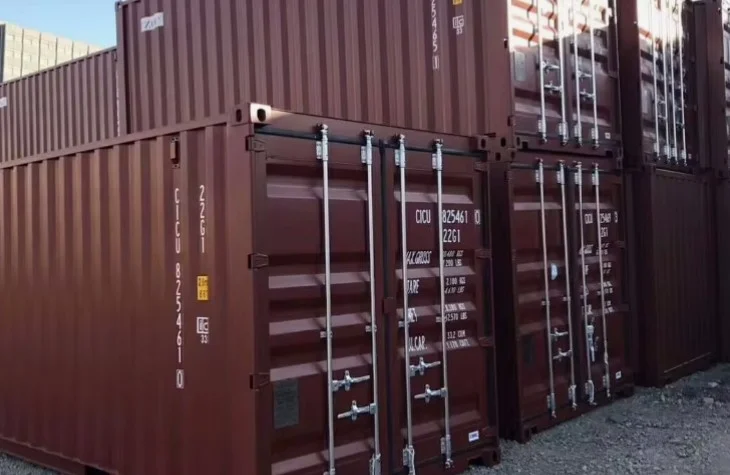
Container Dimensions
Container dimensions refer to standard dimensions determined for the safe, orderly and efficient transportation of cargo in international transportation. These dimensions determine not only how much space the container takes up on the outside, but also how much cargo can be taken inside. Therefore, when talking about container dimensions, technical details such as length, width and height as well as internal volume, door openings and carrying capacity are taken into consideration. The most commonly used containers in practice are 20' and 40' containers, and these dimensions have globally accepted standards.
Correct understanding of container dimensions is critical for sound logistics planning. An incorrectly sized container may lead to loss of space during loading, increased transportation costs or operational disruptions. Container dimensions, especially in commercial transportation; It should be evaluated according to product type, loading method, transportation route and storage need. Therefore, container dimensions are not only technical information, but also a strategic element that directly affects cost and time management.
What are Standard Container Dimensions and How Are They Determined?
Standard container dimensions are determined according to certain rules in order to ensure harmony and continuity in international transportation. These dimensions aim to ensure that containers can be used smoothly in ports, ships, train wagons and land transportation vehicles in different countries. When determining the dimensions, the basic criteria are that the containers can be stacked on top of each other, that they can be transported safely with cranes, and that there are no balance problems during transportation.
Standard sizes are also created based on safety and durability. Containers carry not only the load inside but also the weight of other containers placed on top of each other during transportation. Therefore, the dimensions are designed to support the structural strength of the container. Thanks to standardization, logistics processes are accelerated, transportation equipment can be used jointly, and operational harmony is achieved in global trade. This creates a serious advantage for both carriers and cargo owners.
How Many Meters Are 20' Container Dimensions and For What Purposes Are They Used?
20' containers have a length of approximately 6 meters and are one of the most frequently used container types in transportation. Its width is generally around 2.4 meters, and its height is approximately 2.6 meters in standard models. These dimensions enable the container to be used easily in both sea and land transportation. Internal dimensions are slightly smaller than external dimensions, and this difference is due to the wall thickness and structural elements of the container.
20' containers are preferred especially for transporting heavy and dense loads. Because these containers have high carrying capacity, although they are more limited in terms of volume. It is very suitable for metal products, machine parts, building materials and palletized heavy loads. It is also widely used as warehouse, construction site and temporary storage area. Thanks to its compact structure, it is easier to position and transport in narrow spaces; This makes 20' containers an operationally practical option.
What are the Differences Between 40' Container Dimensions and 20' Container?
40' containers are approximately twice the size of 20' containers in terms of length, which provides a significant increase in internal volume. These containers, which are approximately 12 meters long, are generally the same as 20' containers in terms of width and height. However, thanks to the internal space it offers, it allows more products to be transported at once. This feature is an important advantage, especially for bulky loads.
The difference between the two types of containers is not limited to size; The intended use also makes this difference clear. While 20' containers offer a more balanced solution for heavy loads, 40' containers stand out for light but space-consuming products. 40' containers reduce transportation costs for loads such as textile products, furniture, and packaged consumer goods. However, being larger increases the need for maneuver and space. Therefore, when choosing a container, not only the size but also the weight of the cargo and the environment in which it will be transported should be taken into consideration.
Why Are High Cube Container Dimensions Higher?
High Cube containers are designed to be approximately 30 centimeters higher than standard containers. This extra height increases the internal volume of the container, allowing more cargo to be carried. This difference provides a serious advantage, especially in products with large vertical dimensions. While the height limit may cause problems during loading in standard containers, this limitation is largely eliminated in High Cube containers.
This type of container is generally preferred for transportation where maximum efficiency in terms of volume is desired. Large parcel groups, high pallets and light but bulky products are more easily transported in High Cube containers. Being able to ship more products with the same transportation cost contributes to reducing logistics costs. Therefore, High Cube containers play an important role, especially in international trade and high volume cargo transportation.
For Which Loads Are Flat Rack Container Dimensions Suitable?
Flat Rack containers are special containers that do not have side walls or have a foldable structure. This design makes it possible to transport large, long or heavy loads that would not be possible to fit into standard containers. Although their dimensions are generally similar to 20' and 40' containers, their intended use is completely different. Thanks to its open structure, loading and unloading operations can be done from the top or side.
These containers are mostly used for project loads, work machines, steel constructions, large pipes and industrial products with non-standard dimensions. It is not a problem if the cargo exceeds the container limits; because the load is fixed with special fastening equipment. Flat Rack containers, thanks to their flexible structure, are an ideal alternative for transportation that requires special logistics solutions and come into play when standard containers are insufficient.