What Does the Concept of Logistics 4.0 Mean?
Logistics 4.0 is a new generation operations approach that expresses logistics processes becoming smarter, more connected and more visible with digital technologies. This concept describes not only the computer-aided understanding of classical logistics, but also the transformation of processes into a structure that is fed with data, can be monitored instantly and decisions can be made faster. The basis of this approach is that areas such as order management, warehouse flow, shipment planning, vehicle tracking, delivery performance and customer information are not disconnected from each other, but work with a common system logic. Therefore, logistics 4.0 is not just a technological innovation, but a structural transformation that changes how logistics operations are managed.
In traditional logistics models, many processes are carried out by different teams, different screens and sometimes manual controls. This structure can work up to a certain point in small-scale jobs. However, as order density increases, delivery expectations accelerate, and the need for transparency on the customer side grows, classical methods begin to become insufficient. Late updating of data, lack of interconnection of processes, late detection of error sources, and making decisions intuitively create serious efficiency losses in logistics. Logistics 4.0 stands out as an approach that responds exactly to these problems.
The most important element that increases the value of this approach is that it makes processes not only faster but also more accurate. Because the real need in logistics is not just the movement of shipments. Questions such as which order is at which stage, which warehouse is busy, which line is experiencing delays, which delivery model works more successfully, etc. must be answered clearly. Thanks to logistics 4.0, this visibility is strengthened. Especially in structures supported by logistics software, data flow becomes more orderly and operation management is on a more solid ground.
Logistics 4.0 is also a structure that strengthens human decisions, not removes people from the process. The aim is not to leave all control to technology. The main goal is to reduce repetitive tasks, reduce the possibility of errors, make data visible and enable managers to make decisions with more accurate information. Therefore, logistics 4.0 should be considered as a management model that combines technology and operational knowledge.
Basic Structure of Logistics 4.0 Concept
The basic structure of the Logistics 4.0 concept is based on data, integration, automation, visibility and simultaneous control. The most important difference here is that the process is handled holistically rather than in parts. All steps between the moment the order is placed and the moment the delivery is completed are considered as links of a single chain. Warehouse movement, shipment plan, transportation flow, delivery information and reporting proceed within the same operational logic. Thanks to this structure, not only the results but also the changes experienced during the process are seen more clearly.
At the center of this basic structure is data. The most critical condition of the logistics 4.0 understanding is that the data is accurate, up-to-date and usable in flow. If order information is missing, stock data is not up-to-date, or shipment movements are kept fragmented in different systems, the transformation remains superficial. However, when data is processed correctly, the business begins to see not only what is happening, but also why. This provides a transition from a reacting structure to a predictive structure.
Integration is the second strong pillar of this structure. Logistics processes are often divided into different areas such as warehouse, shipping, transportation, customer communication and reporting. When these areas do not communicate with each other sufficiently, the same information is entered repeatedly, the possibility of error increases, and teams act with different data. The logistics 4.0 approach aims to reduce this disconnection. Proceeding processes with common data not only saves time. It also improves decision quality.
Another building block is automation. Automation here does not only mean robotic systems or physical machines. Performing repetitive control steps by the system, automatic progress of notifications, issuing warnings at certain thresholds and standardizing data entries are also part of this structure. This way, teams' time can be devoted to managing the process, not just executing it. This makes it possible to use the quality of human resources more efficiently.
Prominent Applications in Logistics 4.0 Structure
Real-time tracking systems are one of the prominent applications in the logistics 4.0 structure. Being able to instantly monitor information such as at what stage the order is, where the product is in the warehouse, what route the vehicle is on and how much the delivery deviates from the planned time makes a big difference. Thanks to these applications, businesses can detect problems while the process is ongoing, rather than after the results appear. This increases the speed of intervention and prevents chain disruptions.
Smart planning applications are also important components of this structure. More balanced planning can be made when variables such as order density, vehicle capacity, delivery areas, warehouse workload and time pressure are evaluated together. In classical methods, these decisions are often based on experience and manual evaluation. However, digital planning tools can create more accurate plans by reading historical data and current density simultaneously. This provides higher control in shipping and delivery processes.
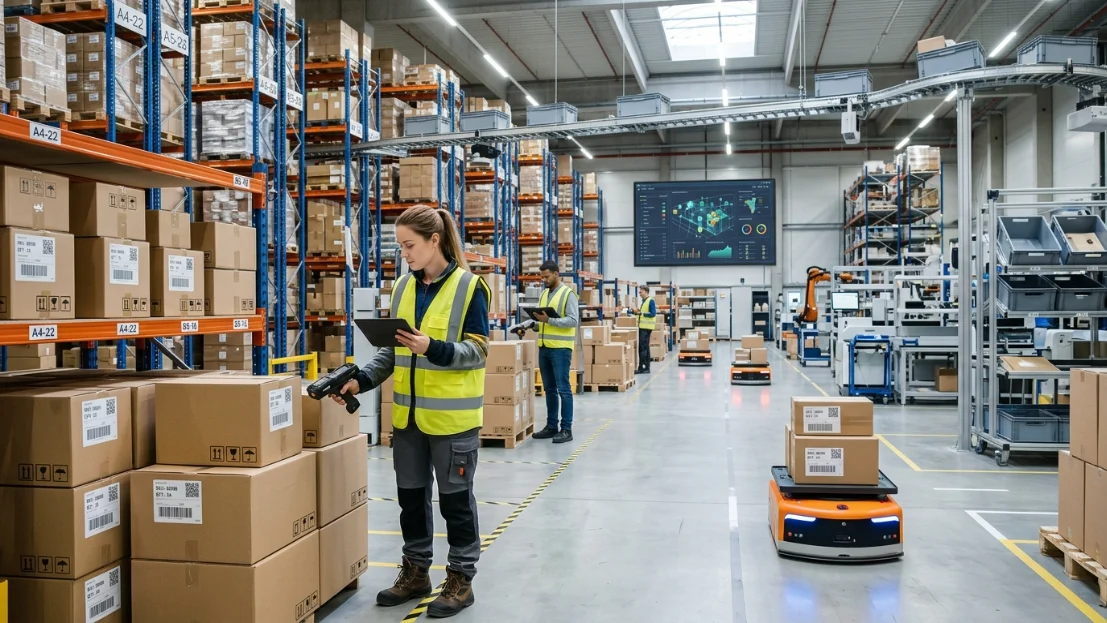
On the warehouse side, applications such as barcoded transaction flow, mobile picking, instant stock movement and location-based tracking stand out. Thanks to these systems, product movement is tracked more clearly, error rate is reduced and preparation time is shortened. These practices are of great importance, as even a small disturbance in the warehouse can affect the shipment chain. It uses the logistics 4.0 approach to not only speed up warehouse processes but also make them more reliable.
Reporting and analysis applications are also among the strengths of this structure. Questions such as which region experiences more delays, which customer types experience delivery problems, which shipping model works more efficiently, and in which process cost pressure occurs, cannot be clarified without regular analysis. The logistics 4.0 structure uses this information not only to look at the past, but also to plan the future more accurately. In this way, businesses can bring together daily operational management and strategic management on the same ground.

The Effect of Logistics 4.0 Approach on Operation Processes
The first major impact of the Logistics 4.0 approach on operational processes emerges in visibility. The more clearly a business can see what is happening at each stage of the process, the more controlled it acts. Reduced uncertainty does not only mean ease of follow-up. It also enables sources of delay and error to be detected earlier. This allows operations teams to manage the process as a live ongoing structure, rather than as a finished result.
The second important effect is seen in process speed. Logistics 4.0 does not always promise absolute speed, but it does reduce unnecessary waiting. Repeatedly entering the same data, slow information transfer between teams, manual approval chains and deficiencies discovered at the last moment extend the total time. This approach reduces such losses, making the process smoother. Thus, not only the total time is reduced, but also the time consistency is increased. In logistics, being able to produce similar quality results every day is as important as speed.
The decrease in error rates is also one of the notable effects. When processes become more visible and more standardized, errors such as incorrect data entry, incomplete transactions, delayed notification or operational discontinuity are detected earlier. This produces more reliable results, especially in areas such as warehouse preparation, shipment flow and delivery accuracy. The reduction in error rate is not only an indicator of quality. It also provides a strong advantage for cost control and customer satisfaction.
Improvement in resource use is also an important effect. Capacity planning can be done more accurately when it is clearer how vehicles, warehouse space, personnel and time are used. Imbalances become more visible, such as overcrowding in some areas while other areas remain empty, excess resources being used on some days and poor performance on others. Thus, the business starts to work not only faster, but also more balanced.
Another important impact is felt in inter-team coordination. The operation becomes much stronger if different units do not proceed with different information for the same process and act on common data. Having warehouse, shipping, customer service and delivery teams see the same picture not only makes communication easier. It also clarifies responsibility and creates a work culture around a common goal. For this reason, the impact of the logistics 4.0 approach is not limited to technology, it also transforms the operation culture.
Points to Consider in Logistics 4.0 Transformation
The first issue to consider in the logistics 4.0 transformation is that this process should not be seen only as a software or hardware investment. Installing a new system, duplicating screens or starting to use digital tools does not alone mean transformation. If the processes still proceed with the old logic, the data flow is irregular and the teams see the new structure only as additional workload, the expected efficiency cannot be achieved. Therefore, transformation should start with process design before technology selection.
The second critical area is data quality. No matter how strong the digital structure is, if the information entered into the system is incorrect, the result will be weak. If stock information is not up-to-date, order data is missing, delivery records are inconsistent, or operation notes are not standard, the established structure cannot produce real benefit. Therefore, one of the most important points to pay attention to in the conversion process is the quality of the data. A strong digital structure cannot be established without solid data.
Team harmony is also one of the areas that determine the success of the transformation. As processes become digital, the way employees do business also changes. This change is not just about learning to use a new screen. It is also necessary to understand why data is being entered, why standard flow is required, and why process visibility is important. If the user side is not included in the transformation, systems will be established but habits will not change. This causes the transformation to remain on paper.
Another point of attention is to proceed gradually. Trying to transform every area at the same time can lead to chaos, especially in large buildings. The healthier approach is to start with the areas that create the most disruption or will produce the most value. For example, gradual transitions such as warehouse accuracy first, then shipping plan, then delivery visibility are more sustainable. In this way, team harmony becomes easier and the impact of the investment can be seen more clearly.
The continuity of transformation should not be forgotten. Logistics 4.0 is not a process that ends with the beginning of a project. The established structure must be measured regularly, user feedback must be taken into account, new needs must be adapted to the system and processes must be updated. The real benefit occurs not at the moment the system is installed, but at the point when it begins to produce more regular, more visible and more controlled operations over time. For this reason, logistics 4.0 transformation should be considered as a constantly evolving management approach, not a one-time installation.