Why is Address Verification Important in Distribution?
Success in distribution operations is often evaluated through vehicle plan, route setup, delivery time and field performance. However, one of the most basic conditions for this entire structure to work correctly is the accuracy of the address information. Even the best route plan can be ruined if the address is wrong or missing. Even if the driver is in the correct area, delivery may be delayed due to incorrect apartment number, incomplete neighborhood information, incorrect phone record or unclear location. This doesn't just affect a single order. It also directly affects the order of other deliveries during the day, vehicle capacity and customer satisfaction. Therefore, address verification is not a small control step of the distribution, but one of the fundamental elements that determine the robustness of the entire operation.
Especially in multi-point delivery structures, address quality becomes more critical. Because the driver must complete many stops during the day, and the loss of a few minutes at each address rapidly increases the total operation time. Looking for the wrong building entrance, confirming incomplete street information, trying to reach the customer again, or dealing with the wrong location on the map creates serious inefficiency at the end of the day. Therefore, address verification in distribution is necessary not only to ensure that the package reaches its destination, but also to maintain the delivery flow of the whole day.
Address verification also determines the customer experience. If the customer has placed an order and is waiting for delivery, his most basic expectation is that the product will reach the right place and within a reasonable time. A shipment that is delayed or undeliverable due to the wrong address damages the credibility of the brand in the eyes of the customer. Moreover, such problems create additional burden not only on the field but also on the call center and customer services side. In short, correct address information is important for brand perception as well as delivery success.
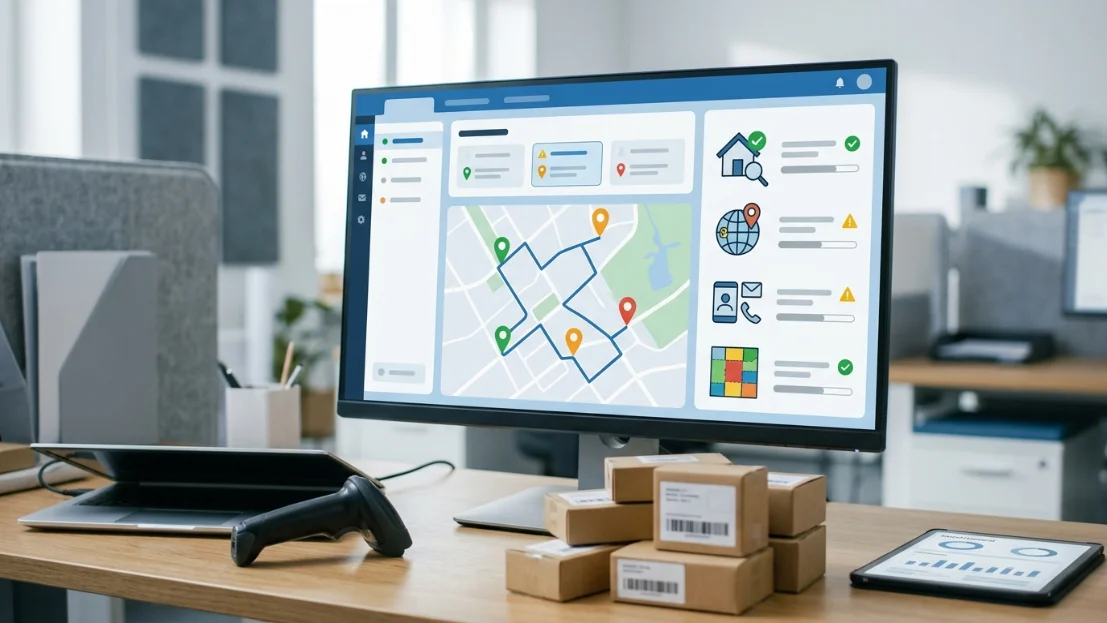
Today, many businesses pay more attention to data visibility to improve distribution quality. At this point, logistics programs make a significant contribution to controlling address records, standardizing order information, evaluating delivery density and address accuracy together, and detecting problematic records early. However, no matter which system is used, the basic truth does not change. When address verification is neglected, the distribution operation does not proceed on a solid basis.

The Role of Address Information in the Operation Process in Distribution
Address information is the starting point of the distribution process. Which vehicle the order will be assigned to, which route it will be evaluated on, which driver will make the delivery, and which part of the day the address will be visited are determined based on this information. In other words, the address is not just a detail used at the time of final delivery. It comes into play at the planning stage of the operation. If this information is incomplete, inaccurate or dispersed, all subsequent decisions will be made on a weak basis.
The role of address information is not limited to just showing location. When the neighborhood, street, building number, block, flat, floor, site name, workplace description and receiver information are evaluated together, the actual delivery point becomes clear. If block information is missing in large sites, the business name is unclear in industrial areas, or if clear direction information is insufficient in rural areas, delivery time will be extended. Therefore, the role of address information in the operation process is not only to show a point on the map, but also to ensure that the delivery is completed smoothly in the field.
Correct address information also increases route efficiency. In order for orders in the same region to be grouped logically, the system must read those addresses correctly. Due to inconsistencies in address writing, two orders in the same district may appear to be far away from each other, or vice versa. This disrupts the vehicle plan. In other words, address quality not only makes the field team's job easier, but also determines the accuracy of the distribution plan.
Address information is also important for customer communication. Pre-delivery information, transportation in case of possible delays, delivery confirmation and re-planning in case of unsuccessful attempts are based on this data. Incorrect phone number or missing contact information makes it difficult for the driver to reach the customer. Thus, the delivery may not be completed even if the correct location is actually reached. In this respect, address information is the basis of communication flow as well as physical delivery.
Effects of Incorrect and Incomplete Address Information in Distribution
The first effect of incorrect or incomplete address information is the extension of delivery time. Even if the driver reaches the correct neighborhood, he/she spends extra time due to the wrong street, missing house number or unclear building name. Especially on busy delivery days, this waste of time is not limited to a single order. It also causes subsequent deliveries to deviate from the scheduled time. Thus, a seemingly small data problem becomes an operational problem that spreads throughout the day.
The second effect is seen in the failed delivery rate. If the address is not clear enough, the delivery cannot be directed to the correct destination and even if the driver reaches the customer, he may have difficulty completing the delivery. In some cases the package will be returned, in some cases a second delivery attempt is required. This means additional vehicle usage, additional labor and additional customer service burden. It is difficult to improve delivery performance without accurate address information.
Another important impact is on the cost side. A vehicle directed to the wrong address consumes more fuel, uses more time and reaches a lower number of daily deliveries. As unsuccessful attempts increase, the cost per delivery increases. Additionally, re-allocation, re-scheduling and new issue preparation may be required on the warehouse side. Therefore, address errors are not only a field problem, but a direct cost problem.
It also has a great impact on customer satisfaction. When the customer learns that the delivery is delayed or sent to the wrong address while waiting for his product, his trust in the brand decreases. This situation gives more negative results, especially if the same customer experiences repeated delivery problems. Delay can sometimes be tolerated, but incorrect delivery attempts or the need for constant address confirmation undermines the quality of service in the eyes of the customer.
Incorrect and incomplete address information also disrupts internal coordination within the company. The sales team, customer service, warehouse and field team have to communicate repeatedly for the same order. This reduces efficiency. However, if the address information was collected correctly and in a standard manner in the first place, there would be no need for this additional coordination burden. Therefore, address quality is important not only for field success but also for internal flow.
Checks Applied in the Address Verification Process in Distribution
The first check in the address verification process is to examine whether the basic fields are complete. City, district, neighbourhood, avenue or street name, building number, flat or independent section information, site or workplace name and delivery person information should not be left blank in the system. When one of these fields is missing, delivery risk increases. So the first step is to check the existence and integrity of the information.
The second check is whether the address complies with standard spelling rules. Systemic confusion may occur if the same region is written differently in one order and differently in another order. Inconsistent use of abbreviations, spelling errors, missing building descriptions, or randomly added descriptions make it difficult to read the address correctly. Therefore, address data must be not only full but also regular.
The third check is the match of location and delivery reality. The point visible on the map and the written address must be compatible. There may be a difference between the written address and the map location, especially in large sites, organized industrial zones, newly developed settlements or rural areas. In such cases, it is risky to place a direct shipment plan without address confirmation. Position control significantly increases delivery accuracy.
The fourth check is to verify contact information. Phone number, delivery recipient information and additional directions if necessary must be up to date. Even if some addresses appear correct on the map, they may be difficult to complete without contact at the time of delivery. Therefore, the address verification process is not just a geographical information check. It is also the control of the communication infrastructure to be used at the time of delivery.
The final control is the evaluation of past delivery experience. If deliveries have been made to the same address before, any problems experienced, reasons for delay or additional explanations should be recorded. Thus, problematic addresses are recognized faster in the future. Using historical data is very valuable to avoid repeating the same mistakes. Companies with strong operations take into account not only the current address but also the delivery history of the address.
Preventing Errors Made During Address Verification in Distribution
The most common mistake made during address verification is processing incomplete information despite the order. Accepting the order as complete even though the house number, block or phone number is missing seems to provide speed in the short term, but creates a much greater loss of time in the field. Therefore, the order with missing fields should be prevented from entering the shipping plan. Prevention begins at the data collection stage.
Another common mistake is to leave the address only as the customer wrote it. Sometimes the customer may habitually enter a short, incomplete or vernacular address. If this information is imported directly into the system, it may cause problems for the field team. Therefore, the address must be made suitable for operational use. Standardization is the important part of validation. The aim is not to keep exactly what the customer wrote, but to make it suitable for delivery.
Not checking the map and written address together is also a serious mistake. In some cases the location may indicate the wrong spot, in other cases the location may be correct even if the written address is missing. Using these two data independently of each other reduces the delivery quality. For prevention, written information and location information must be evaluated together.
Leaving communication control to the background is also a common mistake. Even if the address appears correct, if the person cannot be reached during delivery, the process will be disrupted. Communication accuracy is very important, especially for corporate deliveries, large site deliveries or shipments with sensitive recipient information. Keeping the phone number and delivery person up-to-date is an integral part of address verification.
Finally, not creating systematic learning even though the same mistake is repeated is an important weakness. If the same address problem constantly occurs in certain regions, certain customer types or certain order sources, the root cause must be found. Permanent improvement cannot be achieved if the problem is only solved manually each time. The correct approach is to mark recurring problem areas and establish a control mechanism earlier in subsequent orders.
Address verification in distribution affects delivery success more than meets the eye. It means correct address, correct route, correct order and correct delivery. An incorrect or incomplete address produces delays, increased costs, failed deliveries and dissatisfaction. Therefore, address verification should be treated as a fundamental part of planning, not an afterthought in the operation. The distribution process, which starts with correct information, proceeds in a more controlled and efficient manner in the field.